

Press play to listen to the blog.
Refining has entered a different race. Margins are under pressure, capital is constrained, and expectations around performance and decarbonization keep rising.
The challenge you face is no longer how to build more. It’s how to run better, mile after mile, using the assets you already have. In practice, that pressure shows up in four recurring questions.
Our Profit Improvement Program® (PIP) provides a practical answer by focusing on how your refinery operates day to day. True optimization starts by understanding how the refinery behaves, not how simplified linear models assume it does.
Petro-SIM® technology provides a non-linear, kinetic virtual representation of the refinery. It captures real process constraints, interactions, and tradeoffs. This enables SMEs to identify economically optimal targets that are technically achievable. These targets form the foundation of any credible PIP.
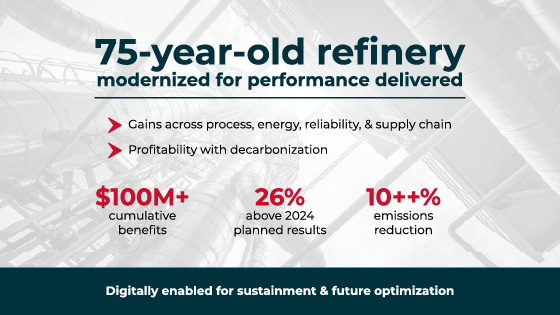
Think of a PIP as a refinery-wide tune-up and optimization rather than a rebuild. Rather than relying on large capital projects, PIPs target yield, energy use, crude selection, reliability, and turnaround execution. In these areas, small, disciplined adjustments compound into real financial impact.
By defining a baseline, identifying opportunities, prioritizing what matters, and acting quickly, you turn operational variability into manageable decisions.
For example, industry benchmarking shows that well-executed improvement programs can deliver tens of millions annually and more than USD 100 million in cumulative benefits via systemic implementation and sustainment.
Value leakage rarely announces itself. It builds quietly through small inefficiencies in energy use, yield losses, reliability, and planning misalignment. Like losing your pace in a marathon from a series of minor missteps, these small losses add up. Over time, they erode millions of dollars each year.
While you can’t control market crack spreads, you can control internal margin variability. Benchmarking shows that incremental inefficiencies can quietly consume several percent of total operating expenditure, translating into millions of dollars lost each year.
By optimizing operations, quantifying losses and ranking opportunities economically, PIPs replace intuition with evidence. What once felt like “the cost of doing business” becomes recoverable value.
Most improvement programs don’t fail because the analysis was wrong. Momentum fades. Ownership blurs. Attention shifts. Value quietly leaks back out.
Field experience shows that you can lose up to 70% of potential value without proper sustainment. Digital PIPs address this by turning projects into performance systems. They integrate engineering models, live plant data, and human decision-making into a closed loop.
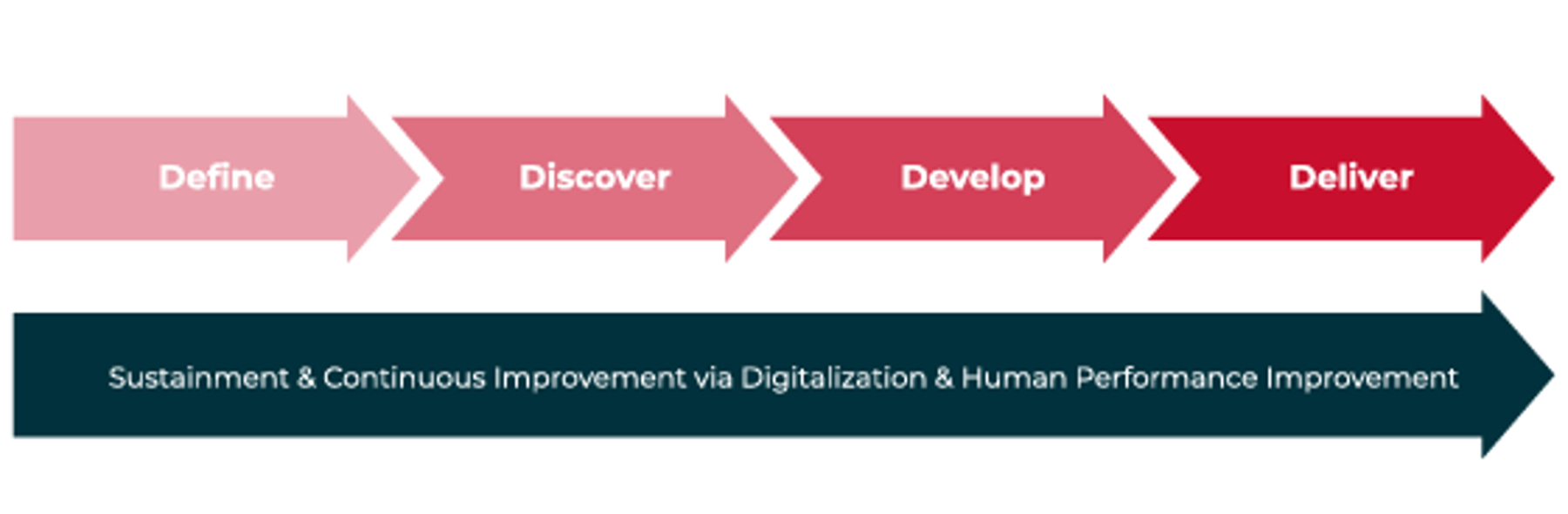
Our five-stage methodology - define, discover, develop, deliver, and sustain - functions like a flywheel. Each turn reinforces the next. It embeds improvement into your daily operations rather than treating it as a temporary initiative. Gains persist, adapt, and compound over time.
In practice, that means aligning planning, operations, and maintenance through shared models and data, and reinforcing performance through people, process, and governance.
Profitability and decarbonization are often viewed as competing objectives. Operational evidence shows they are complementary. The same inefficiencies that erode your margins such as excess energy use, suboptimal yields, and unreliable equipment also drive higher emissions.
Digital PIPs make this connection explicit. They enable you to track energy, emissions, and financial performance simultaneously. Leading programs report energy-intensity reductions of 5–15%, alongside measurable margin uplift.
This dual approach helps you prioritize improvements that lift margins while reducing energy intensity and emissions, supported by relevant and auditable data. When decarbonization is managed alongside operations, it reinforces performance instead of competing with it.
The journey toward low-carbon competitiveness is not a sprint of innovation. It’s a marathon of discipline. By combining SME-led optimization, disciplined implementation, and digital sustainment, PIPs enable refiners not only to protect the plan but to consistently beat it, too. Refiners that succeed treat performance improvement as a continuous, data-driven operating model that’s sustained by people, process, and digital capability while Bringing Decarbonization to Life®.