

Press play to listen to the blog
Delayed coker units (DCUs) drive a disproportionate share of refinery margin — and a disproportionate share of operational complexity. Severe conditions, shifting constraints, and frequent transitions make consistent optimization difficult. Increasingly, refiners are turning to Petro-SIM digital twins and Dynamic Real-Time Optimization (RTO) as part of a closed-loop system that helps you steer DCU performance toward sustained margin and energy gains.
Below are four questions today’s refiners are asking about DCU performance.
DCUs operate under severe conditions. Coke drum operation, furnace severity, feedstock quality, and downstream constraints all are tightly coupled to unit economics. These variables interact in non-linear ways. As conditions change, the optimal operating point shifts rather than remain fixed.
Traditional optimization approaches often struggle because DCU behavior changes over time. In practice, you’re often left leaning on experience and rule-based adjustments to keep throughput, yields, energy use, and reliability in balance.
Without continuous guidance, even small deviations can accumulate into lost margin. For you, profitable DCU operation depends on continuously adjusting operation to stay within safe, stable, and economically favorable limits.
Physics-based digital twins give you a high-fidelity, first-principles view of how your DCU behaves under dynamic operating conditions. When you combine that insight with Dynamic RTO, you’re no longer optimizing around fixed targets or relying on control actions alone. You’re optimizing against economic objectives that matter for yields, energy use, and operating constraints.
In practice, this often means navigating the tradeoff between lower-value coke production and higher-value liquid yields, while staying within tight energy and operating constraints.
The model continuously reconciles plant data and predicts how the unit will respond as conditions change. At the same time, it evaluates economic trade-offs in near real time. Dynamic RTO turns that information into operating guidance that considers constraints, energy consumption, product yields, and operating limits together.

Closed-loop optimization isn’t a single application. It’s a system. In practice, it integrates the digital twin, Dynamic RTO, advanced process control (APC), and the distributed control system (DCS) into a continuous feedback loop.
As shown in the closed-loop architecture (figure 1), economic operating targets are generated by the RTO layer. These targets are implemented through APC within defined operational constraints. Then, plant performance continuously feeds back into the digital twin, enabling the model to recalibrate and adjust operating guidance as conditions change.
For you, this means clear, economically prioritized guidance without sacrificing process stability or control.
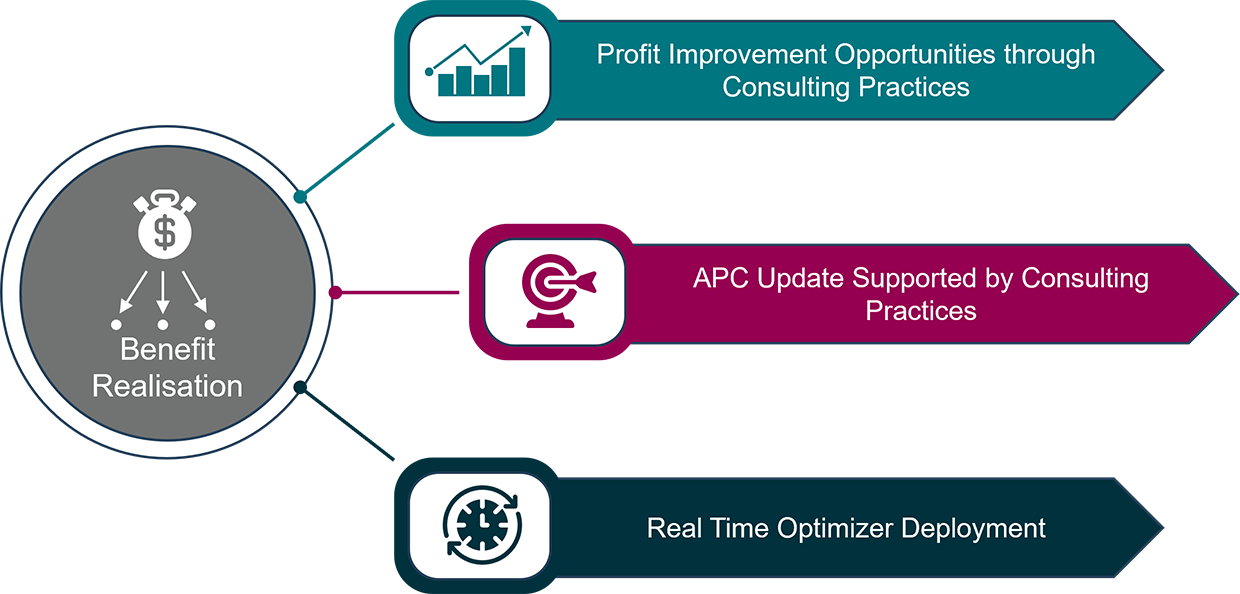
Sustained improvement takes more than periodic optimization exercises. Without continuous guidance, gains achieved during tuning activities can fade as operating conditions, constraints, and feedstock characteristics change.
Closed-loop DCU optimization addresses this by embedding margin and energy objectives directly into day-to-day operations. Dynamic RTO continuously recalculates optimal operating targets, helping you maintain performance as feedstocks, constraints, and operating modes evolve.
Field implementations show that closed-loop optimization can deliver sustained margin improvement alongside lasting reductions in energy intensity and variability. It makes optimization part of normal operations instead of a one-off effort
DCU optimization is no longer about chasing a static optimum. It’s about maintaining control in a complex, dynamic environment. By using digital twins and Dynamic RTO as part of a closed-loop guidance system, refiners can steer DCU performance with greater confidence. Margin, energy efficiency, and operational stability remain aligned over time while Bringing Decarbonization to Life®.
To explore the full methodology and detailed case results, read Improving Delayed Coker Unit Margin.