

Press play to listen to this blog.
Carbon utilization is increasingly discussed as an alternative to sequestration and storage.
Instead of permanently storing CO₂, carbon utilization treats it as a feedstock.
The critical question is not whether CO₂ can be used. The question is: which CO₂ utilization pathways are technically viable, economically credible, and scalable at industrial volume?
Carbon utilization falls into two primary categories.
A) Direct CO₂ use
Examples include carbonated beverages, fire extinguishers, dry ice, agricultural applications, electronics manufacturing, and textile dyeing.
These uses are technically mature. They require relatively simple infrastructure. They do not consume hydrogen. They typically require fewer utilities than chemical conversion routes.
The limitation is scale.
Demand for direct CO₂ use is small compared to emissions from major industrial point sources. Distribution costs can also be significant.
Direct use can contribute to emissions management, but it rarely delivers large volume decarbonization.
B) CO₂ conversion
Conversion pathways chemically transform CO₂ into products such as methane, methanol, sustainable aviation fuel, urea, polyols, and other materials.
Oil and gas recovery is excluded because extracting additional fossil resources does not align with industrial decarbonization objectives.
Conversion is where scale potential exists. It is also where techno-economics becomes decisive.
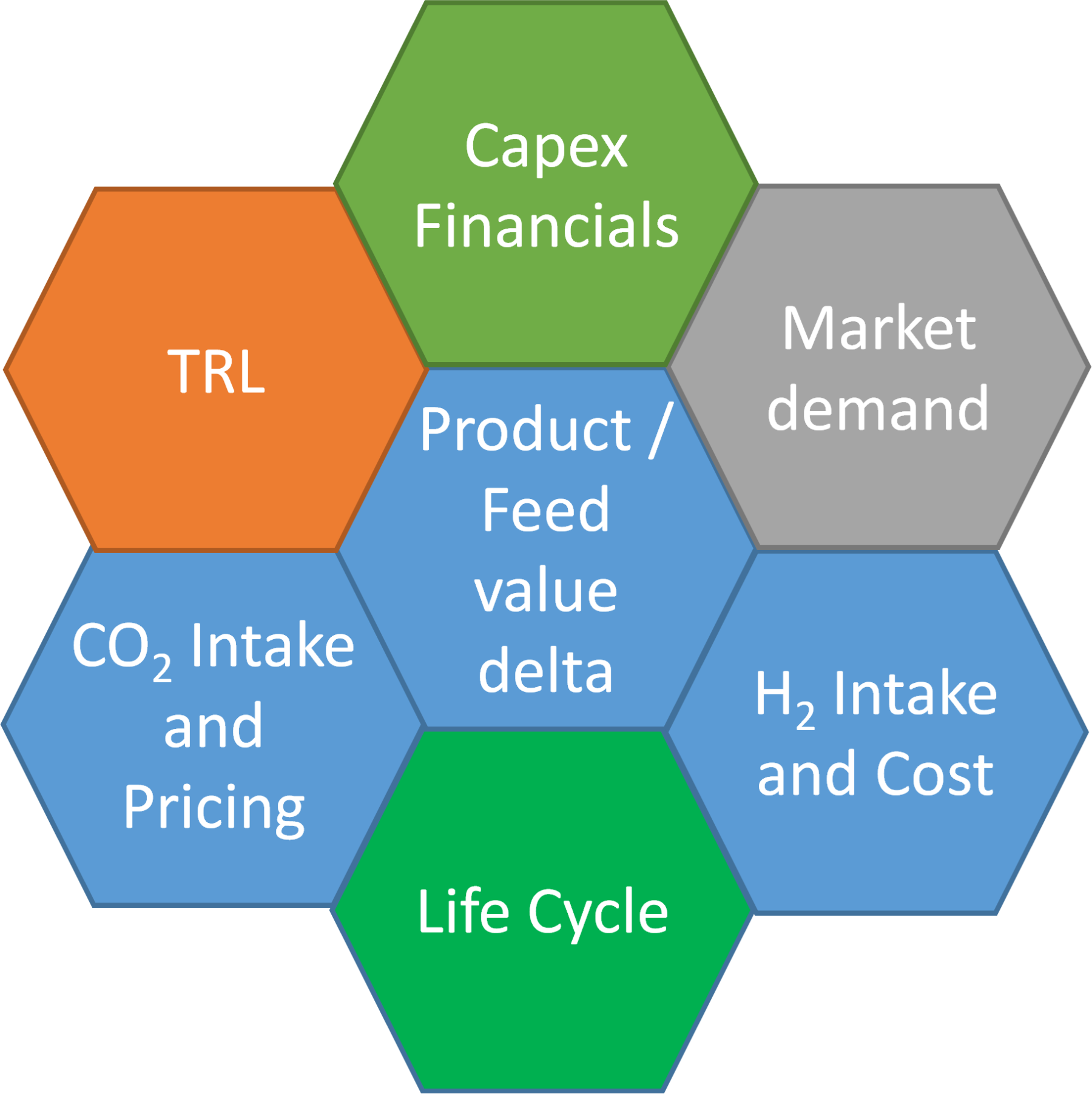
Carbon utilization viability depends on multiple interacting techno-economic drivers, as shown in Figure 1.
Five core variables determine performance:
Each variable influences the others. None can be evaluated in isolation.
Market size is often the first constraint.
CU products are categorized by potential global demand.
Fuels and bulk chemicals operate in Very Large markets (>100 million t/y). Market demand alone will not constrain plant size.
The annual global demand of specialty chemicals that can be produced using carbon utilization, like polypropylene carbonate, on the other hand, is smaller below one million tons. Other CU products, like polyols and butanal, fall into markets with intermediate sizes. Aggressive scaling in smaller markets risks oversupply and rapid price erosion.
For bulk fuels, demand is available.
Not all carbon utilization pathways behave the same. Hydrogen-intensive bulk fuels operate in very large markets. They can scale in principle. Their economics are highly sensitive to hydrogen cost. Lower-hydrogen specialty chemicals often show stronger margins but are constrained by the limited market size.
Most carbon utilization technologies require hydrogen. Because low-cost green hydrogen will not be available to overcome the cost handicap in the short and medium term, some form of support will be required for large-scale carbon utilization.
This support can take the form of direct subsidies, tax exemptions (i.e. indirect subsidies), or mandates. Each option has its advantages and disadvantages. Direct support is relatively simple to implement but becomes costly in large-scale applications. Mandates on the use of products made from CO2 tend to be more cost effective as they introduce a market mechanism. But, they also introduce the risk of market failure.
We have seen this with the 2030 E-SAF mandate in the European Union, where potential investors in E-SAF production capacity struggle to find airlines willing to commit to long-term offtake contracts in a market that traditionally operates on a shorter-term basis.
There is a debate about whether CO2 used for carbon utilization should be used for carbon utilization, or if only biogenic CO2 should be applied. The concern is that combustion of carbon utilization products made from fossil sources still results in fossil emissions, while emissions from biogenic sources are more likely to be offset via biogenic capture by plants.
Ultimately, it should be possible to use both fossil and biogenic CO2. However, an important caveat is that producers of fossil CO2 should remain subject to carbon taxation. The fossil CO2 utilized should also continue to be included in any applicable carbon cap.
A credible carbon utilization strategy begins with disciplined screening:
Carbon utilization scales only when economics, hydrogen supply, market size, technical readiness, and life-cycle performance align. Policy support mechanisms and the source of fossil or biogenic CO2 will also significantly influence whether projects move from concept to commercial deployment.
---
Source
Mertens, J., Mitchell, D., and Wicmandy, M. (2025). “Roadmap to net zero.” In Industrial Decarbonization and the Energy Transition: Innovative Solutions for a Carbon-Free, Sustainable, and Clean Environment. Elsevier.