

Press play to listen to this blog.
Refineries sit at the center of the energy system. They also sit at the center of the industrial emissions challenge.
A 150,000 barrel-per-day refinery emits roughly 200 tons of CO₂ per hour from on-site combustion (Scope 1). It emits another 20 tons per hour from purchased electricity (Scope 2). Globally, refinery emissions could reach 16.5 gigatons between 2020 and 2030.
Scope 1 and 2 are the emissions refiners directly control. Scope 1 emissions are direct combustion emissions generated onsite. Scope 2 emissions result from purchased electricity. Reducing them is the foundation of operational decarbonization.
The challenge: Cut refinery-gate emissions without sacrificing throughput, reliability, or margin.
Most refinery emissions originate from high-temperature combustion processes required for conversion and separation.
Scope 1 emissions primarily come from burning refinery fuel gas and fuel oil in:
These emissions are not incidental. They are built into refinery thermodynamics. High-temperature heat is fundamental for conversion, separation, and upgrading.
Reducing production is rarely a viable decarbonization strategy. Refineries are designed to run at high utilization and efficiency decreases with utilization. Therefore, throughput reduction erodes margin faster than it reduces emissions.
Operational decarbonization focuses instead on reducing emissions per unit of throughput.
Improving energy intensity without cutting production is usually the lowest-capital, lowest-risk lever available. Multi-year optimization programs have been shown to reduce Scope 1 and 2 emissions by 10–20%.
Priority actions include:
Operational decarbonization begins with measurement. Enterprise-wide visibility into energy use and point-source emissions enables continuous correction.
Efficiency is the logical first step because it also is the only decarbonization lever that consistently improves both emissions performance and operating margin.
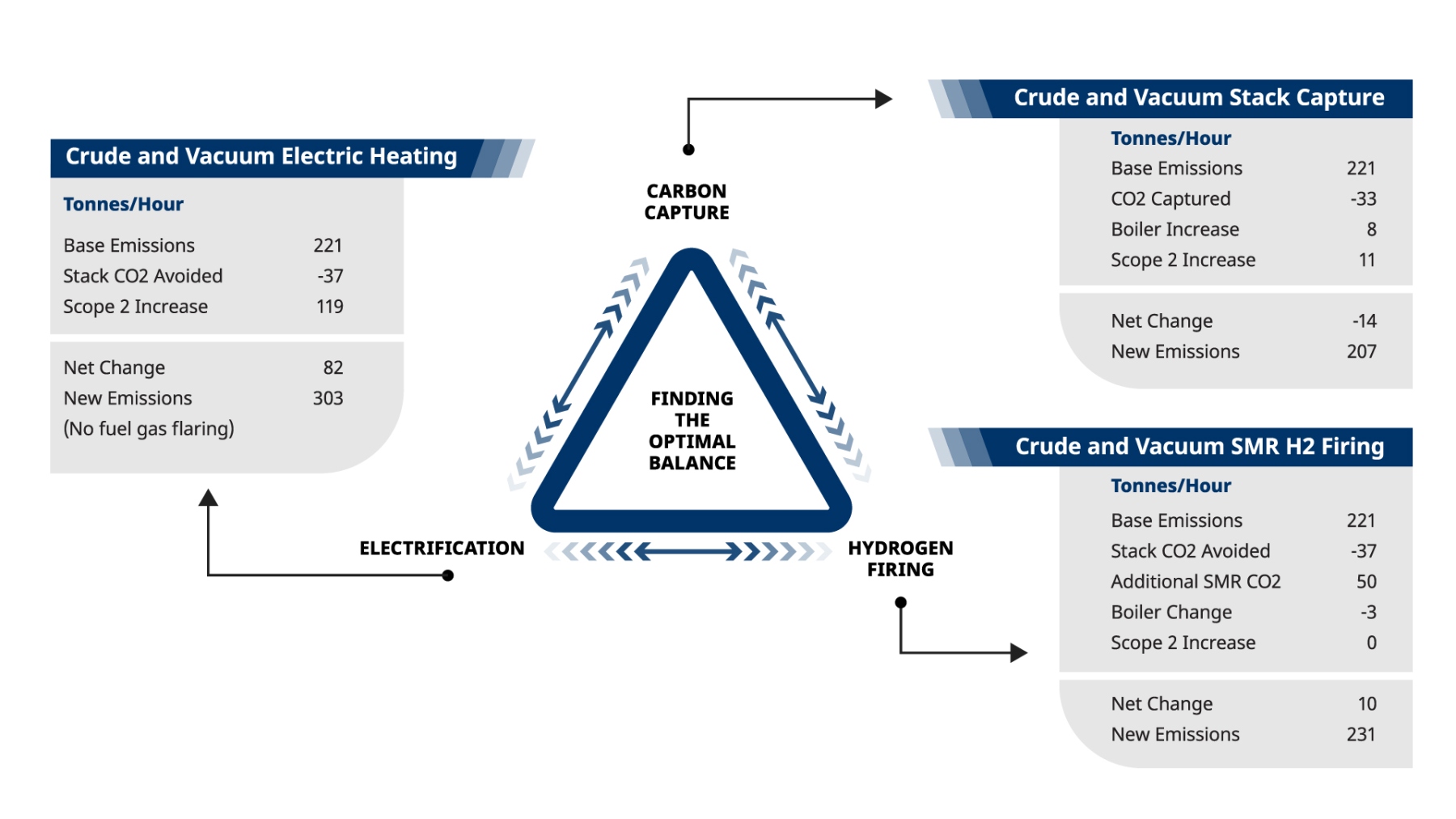
Once optimization gains plateau, deeper reductions require structural changes in how heat and energy are supplied.
As shown in Figure 1, operational abatement clusters into three pathways:
All three pathways are technically viable. All three are capital intensive.
Technology maturity alone does not determine feasibility. System constraints, utility balance, and capital discipline do as well.
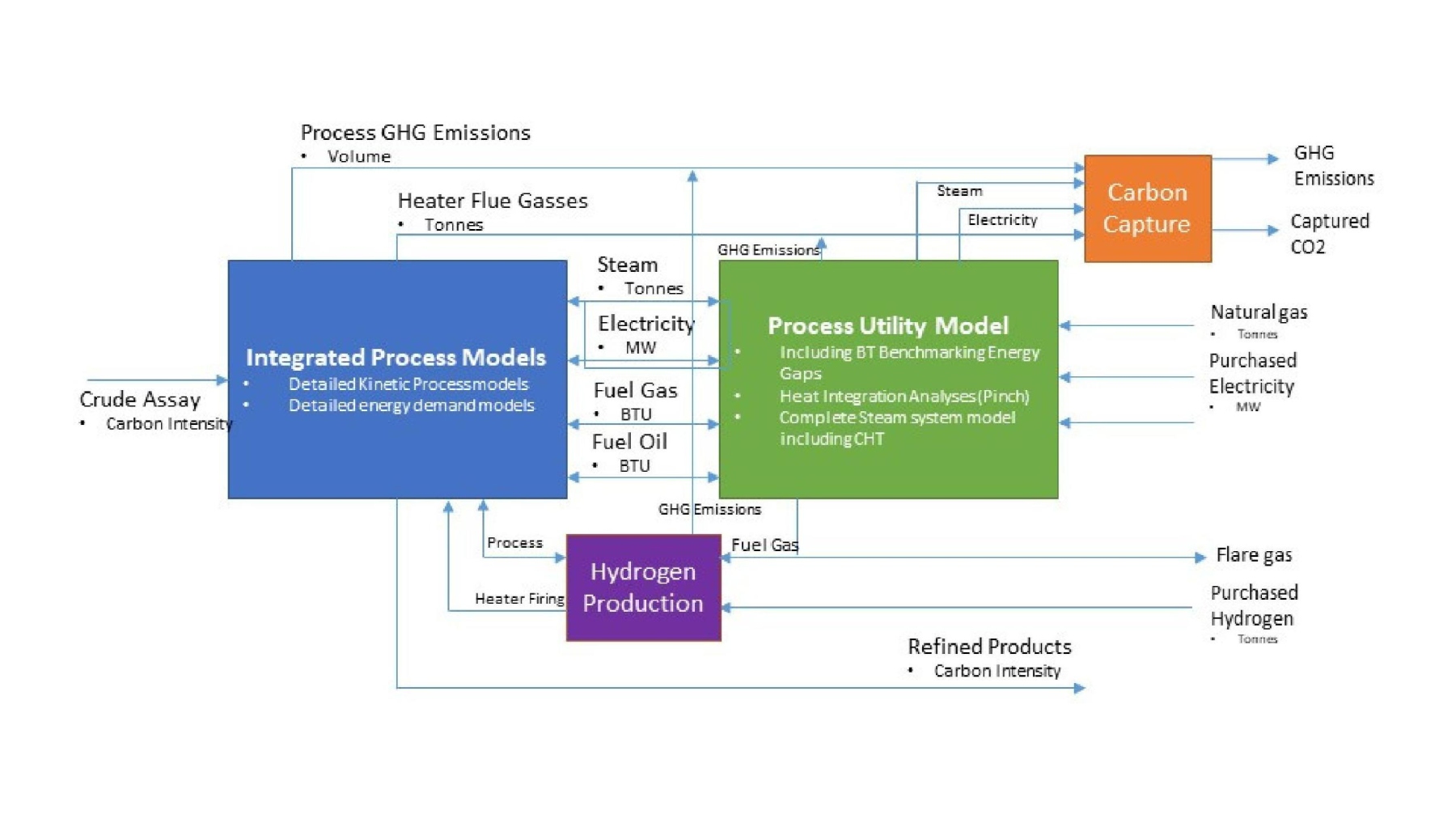
Refineries are tightly integrated systems. Process units, hydrogen networks, steam systems, and utilities operate as one organism.
Decarbonization decisions cannot be assessed in isolation.
Figure 2 shows how the Integrated Process, Energy, and Emissions Model is used for refinery-wide modeling to evaluate decarbonization options within steam, fuel, and hydrogen balance constraints.
Without integrated modeling, investments risk shifting emissions or destabilizing utilities. They can also create operational bottlenecks that erode reliability.
Modern integrated models allow refiners to:
Energy efficiency is typically modeled first. It delivers immediate reductions with limited capital exposure. Structural changes require staged, system-wide analysis.
Operational decarbonization in refining is not a single project. It is an integrated, staged capital strategy focused on reducing Scope 1 and 2 emissions.
Operational net zero in refining will not be driven by aspiration alone. It will be shaped by engineering feasibility and capital allocation.
---
Source
Mertens, J., Mitchell, D., and Wicmandy, M. (2025). “Techno-economic metrics of carbon utilization.” In Industrial Decarbonization and the Energy Transition: Innovative Solutions for a Carbon-Free, Sustainable, and Clean Environment. Elsevier.