

Press play to listen to the blog.
Polyolefins play a vital role in modern society, supporting industries ranging from packaging and construction to automotive and consumer goods. As global demand continues to rise, polymer producers face increasing pressure to improve efficiency, reduce off-grade production, shorten grade transitions, and maintain consistent product quality, while also supporting decarbonization goals.
Achieving these objectives is challenging. Polymerization involves complex reaction kinetics, strong sensitivity to operating conditions, and tight property specifications such as melt flow index (MFI), density, and molecular weight distribution.
To address these challenges, leading producers are adopting advanced process simulation, digital twin technology, and sensitivity analysis as core elements of modern polymer operations.
Polymerizations reactors are highly nonlinear systems in which even small variations in operating conditions can have a significant impact on reactor stability and final polymer quality. Changes in temperature, catalyst activity, hydrogen flow, or monomer composition can quickly alter key product properties such as MFI and density.
Producers must therefore maintain tight control to ensure consistent product quality, avoid reactor temperature excursions, reduce grade transition time, and minimize off-spec polymer production. These challenges become even more complex when scaling up new polymer grades, where uncertainty in reaction behavior can introduce additional operational risk. Traditional laboratory testing alone cannot provide the speed, resolution, or real-time visibility required to manage these complexities effectively during live operations.
Advanced process simulation provides a strong foundation for understanding polymer behavior before changes are implemented in the plant. By representing the underlying reaction kinetics and process interactions, simulation enables engineers to evaluate operating strategies in a controlled, virtual environment.
Using Petro-SIM®, KBC’s rigorous process simulation platform, polymerization reactors can be modeled using advanced kinetic models to predict polymer yield and key properties under varying operating conditions. Simulation allows operating strategies to be validated prior to implementation, helping reduce technical risk during process design, scale-up, and grade transitions. When combined with real plant data, the simulation model evolves beyond offline analysis and becomes the foundation for a high-fidelity process digital twin.
A process digital twin is a continuously updated simulation model that reflects actual plant behavior in real time. In the study presented in the PTQ paper, the digital twin was established by integrating Petro-SIM directly with plant historian data, allowing live operating conditions to be streamed into the model.
Reaction kinetic parameters were calibrated online so that simulated results aligned closely with measured plant performance. This continuous calibration significantly increased confidence in the accuracy of the model. With the digital twin in operation, key polymer properties, including MFI, density, conversion rate, and yield, could be predicted continuously, enabling operators and engineers to anticipate process behavior rather than respond after deviations occurred. This shift from reactive troubleshooting to proactive decision-making represents one of the most important benefits of digital twin technology.
Many polymer plants manufacture multiple product grades on a single production line, making catalyst changes and grade transitions unavoidable. These transitions are among the costliest operational events, as polymer produced outside specification must often be downgraded or discarded.
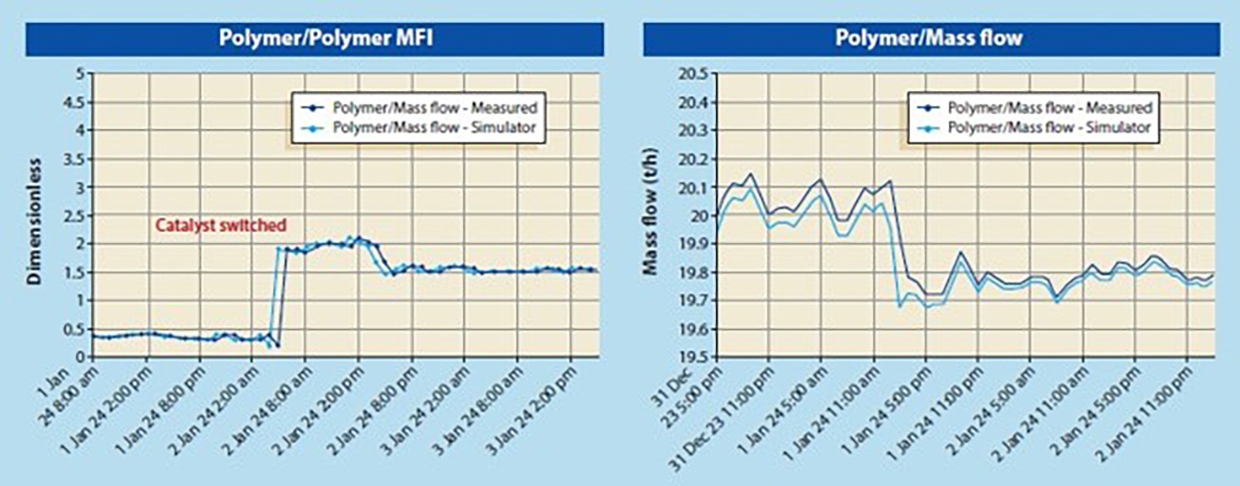
By combining digital twin modeling with sensitivity analysis, engineers were able to predict how polymer properties would evolve during grade transitions. The digital twin enabled estimation of required transition times in advance, optimization of catalyst injection rates and feed strategies, and a significant reduction in trial-and-error adjustments. As a result, transitions could be executed more efficiently, with reduced off-grade production and faster stabilization at the target polymer grade.
In the study, the digital twin successfully predicted MFI changes during catalyst switching, allowing operators to stabilize the process more quickly and significantly reduce off-spec production during transitions
While the digital twin provides real-time visibility, sensitivity analysis delivers critical insight into why the process behaves the way it does. Using Petro-SIM’s built-in sensitivity analysis tools, engineers evaluated the impact of key operating variables such as reactor temperature, pressure, catalyst feed rate, hydrogen flow rate, and monomer and comonomer feeds.
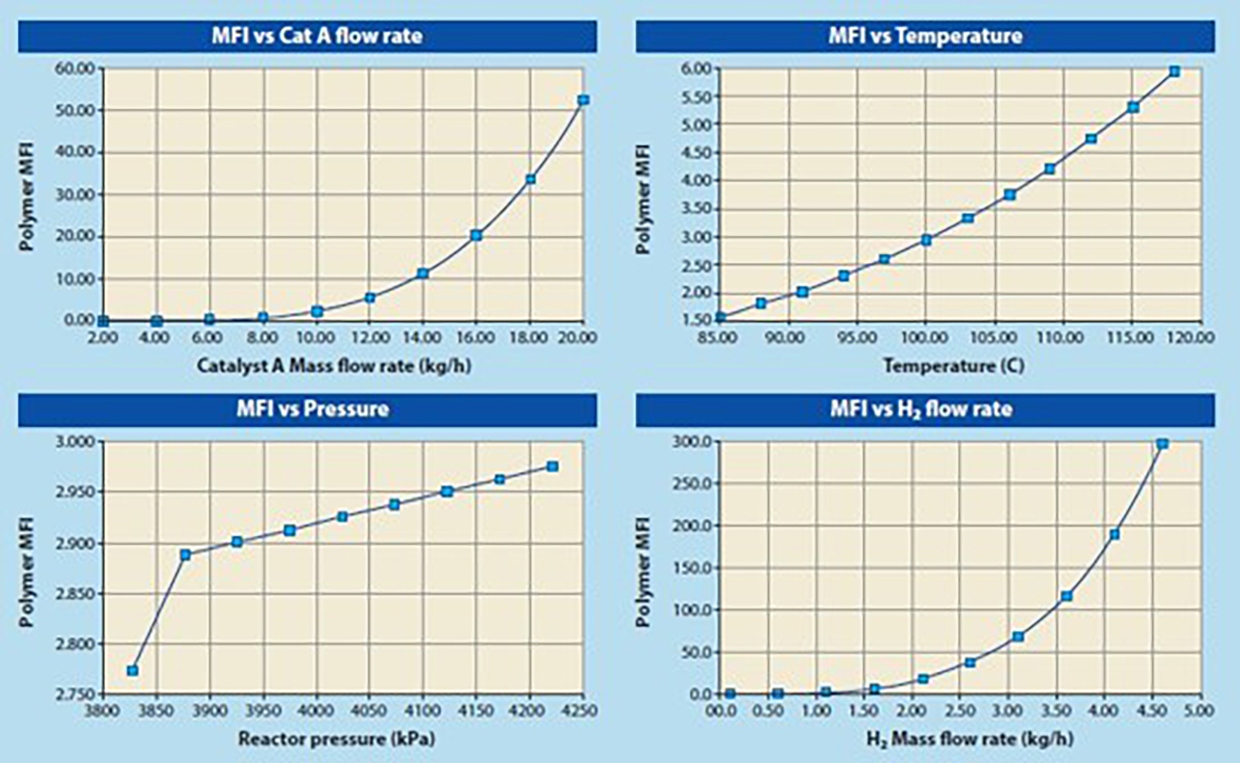
The analysis demonstrated clear relationships between operating conditions and polymer properties. Increases in catalyst rate, temperature, and hydrogen flow were shown to raise polymer MFI, while reactor temperature exerted the strongest influence on polymer density. In contrast, some feed variations were found to have a comparatively minor effect when compared with temperature control. These insights allow engineers to identify which operating levers have the greatest influence on product quality, enabling faster troubleshooting, improved control strategies, and more precise process optimization.
By integrating Petro-SIM process simulation, digital twin technology, and sensitivity analysis, polymer producers gain deeper operational insight, faster grade transitions, and improved product consistency. Predictive modeling of key polymer properties enables tighter specification control, while real-time digital twin visibility supports safer, better-informed operational decisions. The virtual environment allows operating strategies to be tested and optimized before plant implementation, reducing risk, lowering costs, and improving emissions intensity. Together, high-fidelity simulation and digital twin technology transform polymer production from uncertainty into a controllable, repeatable operation, improving profitability while Bringing Decarbonization to Life®.
----
Special thanks to Dr. Michael Wulkow, founder of Computing in Technology (CiT), for his valuable collaboration with KBC in enabling the integration of Predici, CiT’s advanced simulation environment for polymerization kinetics and macromolecular process modeling, within Petro-SIM.